
Categories
Message
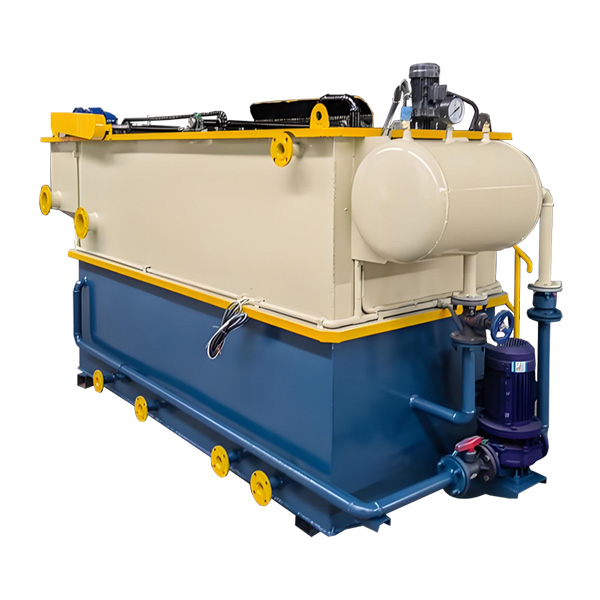
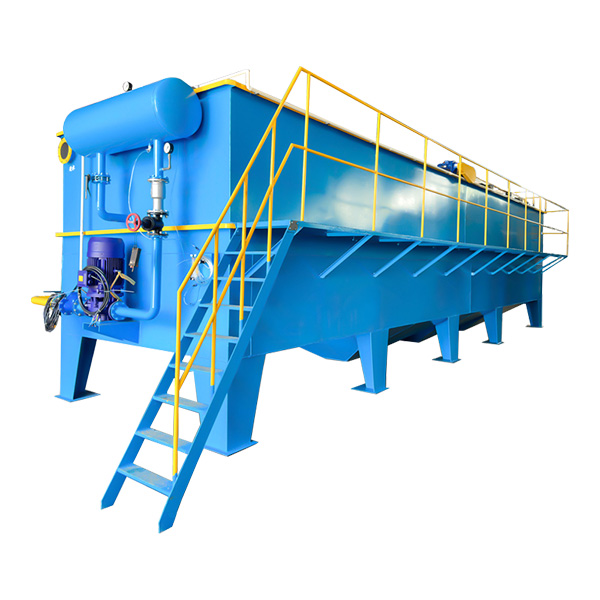
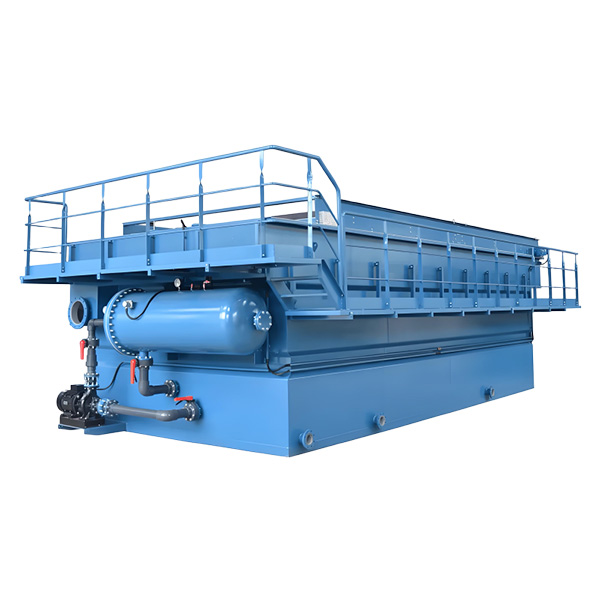
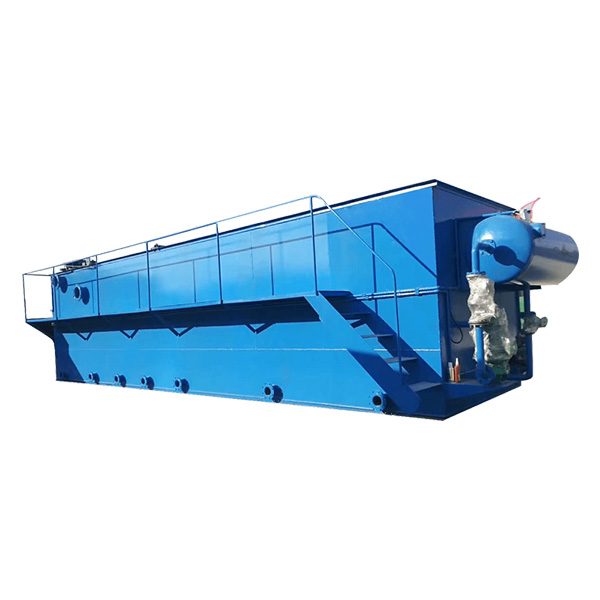
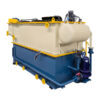
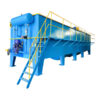
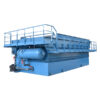
Dissolved Air Flotation
Products Description
Dissolved Air Flotation (DAF) is a high-efficiency wastewater treatment device designed for solid-liquid separation. It effectively reduces pollutants like suspended solids, COD, and BOD in water, making it a reliable choice for various water treatment scenarios.
Working Principle
A portion of treated clear water is pumped into the dissolved air tank under high pressure by a reflux pump. At the same time, an air compressor supplies compressed air into the tank. Under high pressure, air dissolves in water to form high-pressure dissolved air water. This water is released into the contact zone of the flotation tank through a dissolved air releaser. When the pressure drops to normal pressure suddenly, air is released as tiny bubbles (about 20-40 microns in diameter). These bubbles collide with and adhere to suspended particles in wastewater, forming flotation bodies. These bodies rise to the water surface under buoyancy to form a scum layer, which is then removed by a scum scraper to complete solid-liquid separation.
System Components
The DAF system consists of six key modules, each playing a crucial role in the treatment process:
- Chemical Dosing Module: Equipped with PAC/PAM dosing equipment to add coagulants for better particle aggregation.
- Dissolved Air Module: Includes a dissolved air tank, air compressor, and water pump to generate dissolved air water.
- Flotation Tank: Divided into contact zone and separation zone, where the flotation reaction and solid-liquid separation take place.
- Release Module: Uses releasers to release tiny air bubbles from the dissolved air water.
- Scum Scraping Module: Features a scum scraper to remove the scum layer from the water surface.
- Control Module: Manages the overall operation of the equipment to ensure stable performance.
Key Features
- High Efficiency & Large Capacity: It offers high treatment efficiency and large processing capacity, while occupying less space compared to traditional separation equipment.
- Simple Structure & Easy Maintenance: The process and equipment structure are straightforward, making it easy to operate and maintain.
- Fine & Stable Bubbles: The generated bubbles are tiny, uniform in size, and have high density, which ensures stable flotation with minimal disturbance to the liquid, making it suitable for separating fine particles and loose flocs.
- Cost-effective: It reduces the dosage of coagulants and shortens reaction time. The produced scum has high concentration, resulting in less sludge that is easy to dewater.
- Excellent Effluent Quality: It delivers high-quality effluent with low investment and quick returns.
System Types
Based on water flow direction, DAF systems can be categorized into three main types:
- Horizontal Flow DAF System: Water flows horizontally through the flotation tank, suitable for large-scale wastewater treatment.
- Upflow DAF System: Water flows upward in the tank, ideal for small to medium-sized treatment projects.
- Radial Flow DAF System: Water flows radially from the center to the edge of the tank, suitable for specific application scenarios.
Application Fields
The DAF system is widely used in various industries and scenarios:
- Industrial Wastewater Treatment: Applied in papermaking, printing and dyeing, leather processing, electroplating, textile, petroleum, chemical, food and other industries for wastewater purification.
- Drinking Water Treatment: Used to remove suspended solids and impurities from raw water to meet drinking water standards.
- Sludge Concentration: Helps concentrate sludge to reduce its volume for easier disposal.
- Resource Recovery: Can recover valuable substances from industrial wastewater, improving economic benefits.